
NFT Products
Adding NFT gifting to your products can significantly enhance customer interaction and brand perception. In our app, you can select which products in your store will carry this exciting feature. Here’s a guide on how NFT Products work, and how you can leverage them to delight your customers.
What is an NFT product?
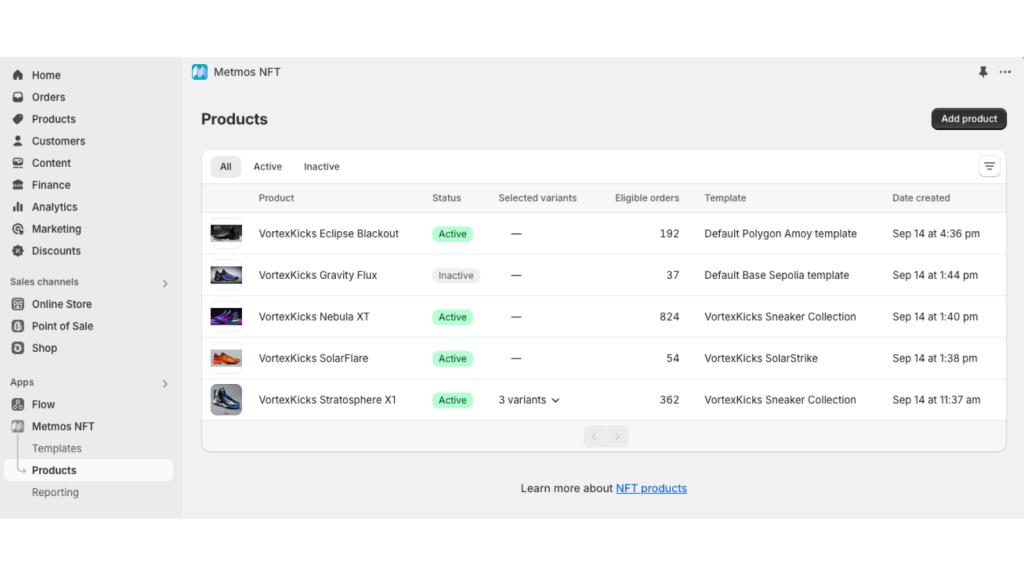
An NFT Product refers to any product in your store that has been enabled to trigger the creation of an NFT upon purchase. This process uses the existing product information such as name, description, and image, along with specific metadata defined in your templates, to create a unique NFT that represents the purchased item.
How to enable NFT gifting for products
Enabling NFT gifting is a straightforward process:
- Selecting products: you can browse or search through your existing inventory and select the products or variants you want to associate with NFT gifting.
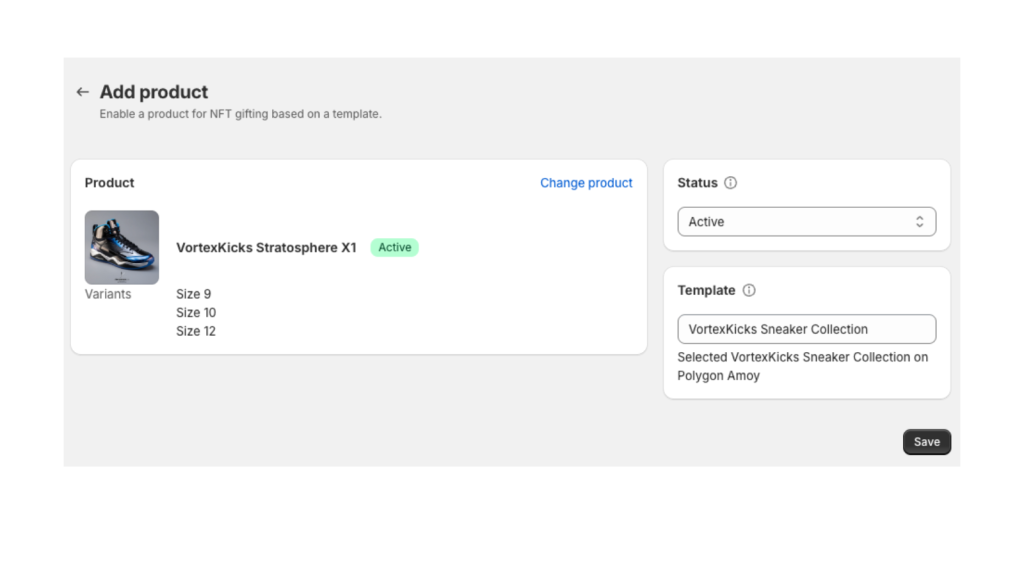
- Template assignment: Once a product is selected, you’ll assign it to a specific template that defines how its corresponding NFT will be minted. This template includes blockchain settings, collection types, and other relevant parameters ensuring that the NFTs align with your branding and customer engagement goals. Learn more about Template.
- Activating NFT features: After selecting the products and assigning the templates, simply activate the select product. This will automate the NFT minting process whenever the product or variant is purchased.
Using NFT Products: Opportunities and Benefits
NFTs can significantly enhance customer engagement and increase the perceived value of your offerings. Here’s when to consider using them and the benefits they bring:
- Special editions: Use NFTs to enhance the value of limited edition items, serving as a digital certificate of authenticity that makes the item more collectible and valuable.
- Brand engagement: Keep customers engaged by offering NFTs as collectibles that enrich their interaction with your brand, fostering a continuous connection.
- Promotional events: Leverage NFTs during special sales or events to create buzz and excitement, making these occasions more memorable and engaging.
- Enhanced customer experience: Offering NFTs adds an innovative layer to the shopping experience, which can differentiate your products from competitors and make the customer experience more intriguing and enjoyable.
- Streamlined operations: Automating the NFT minting process linked to product sales simplifies your operations while ensuring each NFT is uniquely tied to its specific product, enhancing operational efficiency.
Identifying products
Choosing the right products to associate with NFTs can significantly enhance your marketing strategy and customer engagement. Here are some ideas on selecting products from various categories that could benefit from NFT integration.
Digital Products as NFTs
Digital products are inherently suited for NFTs due to their non-physical nature and ease of distribution. Here are a few examples:
- Art and illustrations: Digital art, such as illustrations, graphic designs, and photography, can be tokenized to establish proof of authenticity and ownership.
- Music and audio: Albums, tracks, or soundscapes can offer exclusive listening rights or special content through NFTs.
- E-books and publications: Tokenizing digital books or magazines can restrict access to buyers, adding a layer of exclusivity.
- Video content: Use NFTs for online courses or tutorials to control access to educational material.
- Membership and tickets: Offer NFTs as a gateway to exclusive communities or events, enhancing customer loyalty and interaction.
Physical Products as NFTs
While digital products naturally align with NFT capabilities, certain physical items also stand to gain:
- Limited editions and collectibles: Fashion items, action figures, or any limited-run products can benefit from NFTs as a certificate of authenticity or ownership.
- Art and crafts: Original artworks, prints, or unique crafts like pottery can use NFTs to secure their value and provenance.
- Jewelry and decor: Custom or designer pieces can use NFTs to confirm authenticity and ownership history.
- Tech products: High-demand gadgets can include NFTs to add value and provide proof of purchase.
- Specialty products: Items like custom sneakers or handmade beauty products can use NFTs to enhance their marketability and uniqueness.
How different merchants can leverage NFT gifting
Here’s how different types of merchants might leverage NFT gifting:
Dropshipping and Print on Demand
For brands utilizing dropshipping or print on demand, NFTs serve as a unique marketing tool to:
- Brand differentiation: Set your products apart in a competitive market by offering a digital asset alongside the physical product.
- Customer engagement: Engage customers beyond the point of sale by providing digital perks or future discounts via NFTs.
Direct-to-Consumer (DTC) Brands
Brands that control the production and sale of your products directly to consumers:
- Product authentication: Use NFTs to authenticate products and provide a verifiable ownership history.
- Exclusive content: Offer NFTs that grant access to exclusive content related to the product, enhancing the customer’s purchase experience.
Digital Product Sellers
Sellers of digital goods such as music, ebooks, or software can benefit greatly from NFTs:
- Digital rights management: Use NFTs to manage the rights and distribution of digital products.
- Authenticity verification: Ensure the authenticity and originality of digital content, making it more valuable to the consumer.
Subscription Services
Stores offering subscriptions for products or services can integrate NFTs to:
- Membership perks: NFTs can manage subscriptions and offer exclusive membership perks, adding significant value to the subscription model.
- Loyalty programs: Incorporate NFTs into loyalty programs to incentivize long-term customer engagement and reward.
Wholesale Businesses
Businesses selling products in bulk can use NFTs for:
- Inventory management: Improve inventory tracking and verification of large-scale purchases.
- Exclusive deals: Offer NFTs as a part of exclusive B2B deals to enhance business relationships and transactions.